Guide for parents
Choosing a first instrument for a small child
Most first instruments are played enthusiastically for about nine days and then live under the sofa. This is a guide to why that happens, and what to look for instead — written by someone who builds these things, and who has opinions.
Why the fortnight happens
A two-year-old handed a toy keyboard is not failing to practise. They're responding honestly to an instrument that gives them nothing back. Three things kill early interest, almost always:
- It sounds bad. Cheap musical toys are usually harsh, out of tune, and monophonic. Children have excellent ears — they simply can't tell you "the intonation is unpleasant", so they just stop reaching for it.
- Effort in, nothing out. On a real piano or guitar, weeks of work separate a beginner from their first satisfying sound. Adults can hold that gap open with willpower. A three-year-old cannot, and shouldn't have to.
- It can be played wrong. The moment a child learns that some of the things they do produce a "bad" result, exploration stops and anxiety starts. This is the big one.
What actually works at 2–6
The instruments that survive in this age group share a pattern:
| Quality | Why it matters at this age |
|---|---|
| Beautiful sound from second one | The reward has to arrive before the effort, or there's no second attempt. |
| No wrong answers | If everything they do sounds good, they experiment. Experimenting is the whole thing. |
| Big physical gestures | Fine motor control isn't there yet. Sweeping, banging and pressing work; fretting and fingering don't. |
| Songs they recognise | Familiarity is what turns "making noise" into "playing a song", which is what makes them proud. |
| Infinite patience | Anything with a timer, a buzzer or a fail state teaches a small child that music is a test. |
| Real harmony underneath | Their ear is being trained whether you plan it or not. It may as well be trained on actual chords. |
The traditional options, honestly assessed
Percussion — shakers, tambourine, a small drum
Genuinely excellent, and unbeatable value. Rhythm is the first musical skill to develop and these deliver it immediately. The limitation is melody and harmony: they don't offer any, so children tend to plateau. Buy some anyway.
Xylophone / glockenspiel
A good one, tuned properly, is a lovely thing. Look for real metal bars rather than plastic. The catch is that a diatonic bar layout still lets a child hit notes that clash with each other, and many cheap ones arrive noticeably out of tune.
Ukulele
Superb from around six or seven. Below that, small hands can't hold down a chord shape cleanly, so it mostly produces a buzz — and it needs retuning constantly, which becomes your job, forever.
Toy keyboards
Usually the worst value in the category. Demo songs that play themselves teach passivity, the sounds are thin, and the batteries always die at the worst moment. A real keyboard is a wonderful thing later; a toy one rarely leads to it.
Music apps
The best of them do something no physical instrument can: guarantee that every touch produces something musical. The worst are advertising delivery systems aimed at children. Which brings us to the checklist.
How to judge a children's music app
Before installing anything, check the App Store listing for these:
- In-app purchases. Scroll down the listing. If there's a list of them, your child will find them.
- The privacy label. "Data Not Collected" is the standard to hold out for. Anything tracking a four-year-old for advertising should be an instant no.
- Ads. Including "rewarded" video ads, which are the worst version — they teach a child to watch adverts to earn things.
- Outbound links. Any tappable thing that opens Safari or the App Store is a door your child will eventually walk through.
- Offline. If it needs a connection, it won't work in the car, which is where you need it most.
- A parent gate. Settings should sit behind a press-and-hold or similar, not a tap.
- Subscription. For a children's music toy, this is almost never justified.
Where Wonderchord fits
We built Wonderchord against exactly that checklist — and yes, we made it, so weigh this accordingly.
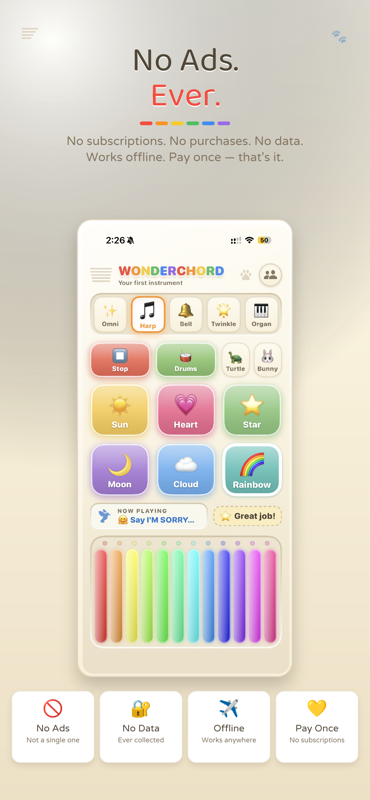
It's an electronic autoharp rebuilt for ages 2–6. Your child presses a colour pad and sweeps twelve rainbow strings. The strings retune themselves to whatever pad is held, so a wrong note is not available to them — they can only make music. Five warm voices, drums at turtle and bunny speeds, and nine songs they already know with the words appearing on screen as they're sung.
"Wait for me!" mode turns any song into a lesson that pauses at every chord change until they play the glowing pad, however long that takes, and gives a star for finishing. Nothing buzzes and nothing fails.
And against the checklist above:
- No in-app purchases — there is no purchase mechanism inside the app at all
- No ads of any kind, including rewarded video
- Privacy label reads Data Not Collected; no accounts, no analytics
- No links out of the app — nothing to tap that leaves it
- Fully offline; no connection needed or made, ever
- Grown-ups area behind a press-and-hold parent gate
- £4.99 once, Family Sharing for up to six people, free updates
Hand this page to your child
There's a working rainbow on the Wonderchord page — real strings, real voices, no download, no email, no purchase. Let them sweep it for two minutes and you'll know immediately whether it's for them.
Try the rainbowWhat we'd actually recommend
A basket of decent percussion for rhythm, a properly tuned glockenspiel if you can stretch to a good one, and something — app or otherwise — that lets them produce real harmony without needing motor skills they don't have yet. Then get out of the way.
The goal at this age isn't skill. It's the belief that music is a thing they can do. Everything else follows from that, and nothing substitutes for it.
Published 7 August 2026 · Written by Connor Clements